 Image credit: Unsplash
Abstract
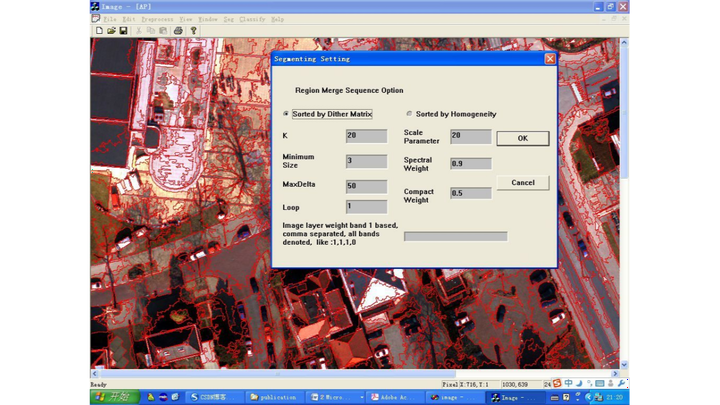
This paper presents an inversed quad tree merging method for hierarchical high-resolution remote sensing image segmentation, in which bottom-up approaches of region based merge techniques are chained. The image segmentation process is mainly composed of three sections: grouping pixels to form image object/region primitives in imagery using inversed quad tree, initializing neighbor list and region feature variables and then hierarchical clustering neighboring regions. This segmentation algorithm has been tested on the QuickBird images and been evaluated and it exhibits good efficiency over initialization of neighbor list for quad tree node/region primitives. This paper also provides a brief proof of the good efficiency of a sorted merge list which can be viewed as an alternative for dither matrix to randomly distribute region merging pairs which is adopted in e-Cognition.
Problem
Large amounts of remotely sensed imagery are being captured, necessitating automatic interpretation. One probably important step in understanding an image is to segment it into meaningful regions of pixels. How can the remotely sensed images be segmented efficiently while facilitating subsequent semantic analysis?
Method
The graph-based segmentation or an inverse quadtree merging method clusters neighboring image pixels into region primitives. Then a hierarchical region growing technique grows these regions by iteratively merging neighboring regions satisfying color, proximity, and border constraints. To evenly distribute pairs of candidate regions for merging, the ordering of candidate pairs based on an increasing merging cost and the ordering based on a dither matrix have been implemented.
Key results
These segmentation approaches were used to segment high resolution remotely sensed images, achieving comparable performance to the hierarchical method in eCognition and the watershed transform method in ENVI.
Related papers: